

Introduction
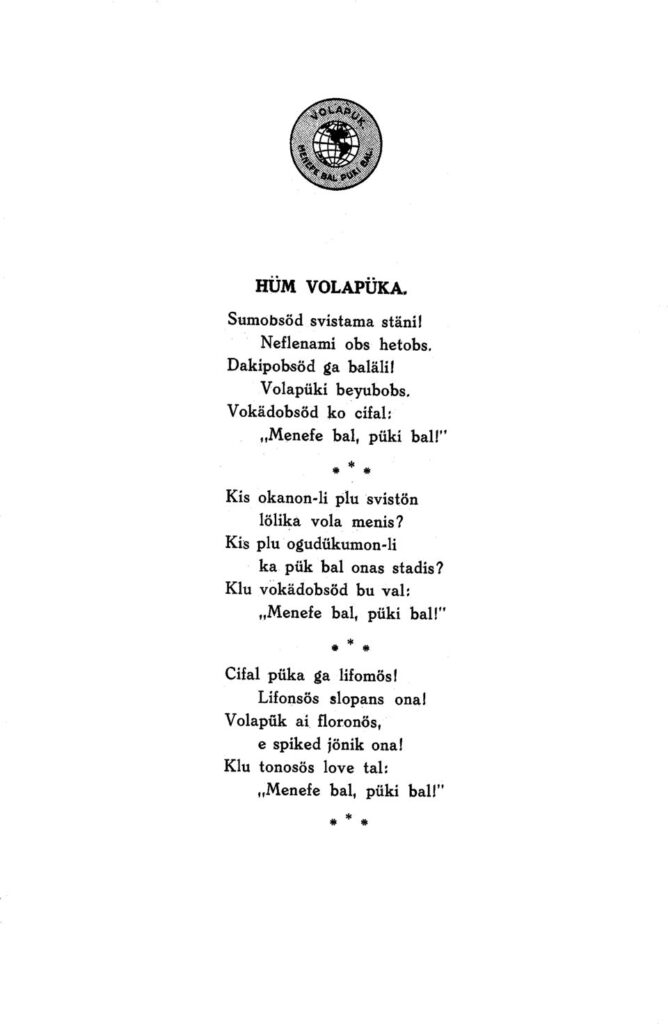
Before Esperanto, before Ido, and before most modern planned languages, there was Volapük — the first constructed international auxiliary language to achieve worldwide attention. In the late 19th century, Volapük briefly captured the imagination of scholars, intellectuals, and idealists who believed humanity could be united through a shared means of communication.
Though largely forgotten today, Volapük played a crucial role in shaping the future of constructed languages. Its rise and fall offered invaluable lessons that directly influenced the design and philosophy of later projects.
—
The Creation of Volapük
Volapük was created in 1879–1880 by Johann Martin Schleyer, a German Catholic priest. According to Schleyer, the idea for the language came to him during a moment of spiritual inspiration, in which he felt divinely guided to create a universal language that could bridge nations and cultures.
The name Volapük comes from modified English words:
vol (from world),
pük (from speak),
meaning “world speech.”
Schleyer envisioned Volapük as a neutral international language that would facilitate diplomacy, science, commerce, and peace.
—
Early Success and Rapid Expansion
Volapük’s success was swift and unprecedented for a constructed language at the time. Within a few years:
Volapük societies were established across Europe and the United States.
Hundreds of clubs, journals, and textbooks were published.
International Volapük congresses were held.
Thousands of learners actively studied the language.
For a brief period in the 1880s, Volapük was widely regarded as the leading candidate for a global auxiliary language.
—
Structural Characteristics of Volapük
Despite its ambition, Volapük had several structural features that later proved problematic.
1. Highly Modified Vocabulary
Volapük drew much of its vocabulary from European languages, especially English, but altered the words so heavily that they became almost unrecognizable.
For example:
vol (world),
pük (speak),
löfik (love).
This extreme modification reduced international recognizability — one of the key qualities needed for a universal language.
—
2. Complex Grammar
Volapük’s grammar included:
four grammatical cases,
extensive verb conjugations,
complex inflection systems,
unfamiliar phonetics for many learners.
While internally consistent, the system was difficult to master, especially for beginners.
—
3. Limited Flexibility
Schleyer insisted on maintaining strict control over the language, resisting proposed reforms that could have simplified Volapük or made it more accessible. This rigidity would become one of the language’s greatest weaknesses.
—
Internal Conflict and Decline
As Volapük spread, its community began to fragment. Many supporters believed the language needed reform to survive. However, Schleyer refused to allow changes, asserting his absolute authority as the creator.
This led to:
ideological splits,
loss of confidence among learners,
departure of prominent supporters.
The movement collapsed rapidly in the late 1880s, just as Esperanto emerged with a simpler, more flexible design.
—
Volapük vs Esperanto
The contrast between Volapük and Esperanto is striking:
Feature Volapük Esperanto
Grammar Complex Simple
Vocabulary Heavily altered Recognizable
Reform Rejected Community-driven
Creator control Absolute Relinquished
Esperanto learned from Volapük’s mistakes, emphasizing simplicity, adaptability, and community ownership.
—
Legacy and Importance of Volapük
Although Volapük failed as a mass language, its historical importance is immense.
1. The First Proof of Concept
Volapük demonstrated that people were willing to learn a constructed language for international communication.
2. A Warning About Over-Engineering
It showed that excessive complexity can undermine usability.
3. A Lesson in Linguistic Governance
The language’s collapse highlighted the importance of community participation and flexibility.
—
Volapük Today
Today, Volapük survives only as a historical curiosity. A small number of enthusiasts still study and preserve it, but its role is primarily educational.
However, its influence lives on in every constructed language that followed.
—
Conclusion
Volapük was a bold, flawed, and ultimately transformative experiment. Though it failed to become the world’s language, it paved the way for all others.
In the history of human attempts at unity through language, Volapük stands as the first great dream — a reminder that ambition must be balanced with accessibility, and that even failed ideas can change the course of history.