
Introduction
Among all constructed and revealed languages, Enochian occupies a unique and controversial position. It is neither a typical constructed language created for communication nor a fictional artlang designed for entertainment. Instead, Enochian presents itself as a revealed language — a language claimed to have been received through supernatural or divine means.
Associated with angels, mysticism, and esoteric knowledge, Enochian has fascinated linguists, occultists, historians, and artists for centuries. Whether viewed as a genuine spiritual system, an elaborate symbolic construction, or a proto-conlang shaped by human imagination, Enochian remains one of the most enigmatic linguistic creations in history.
—
Historical Origins
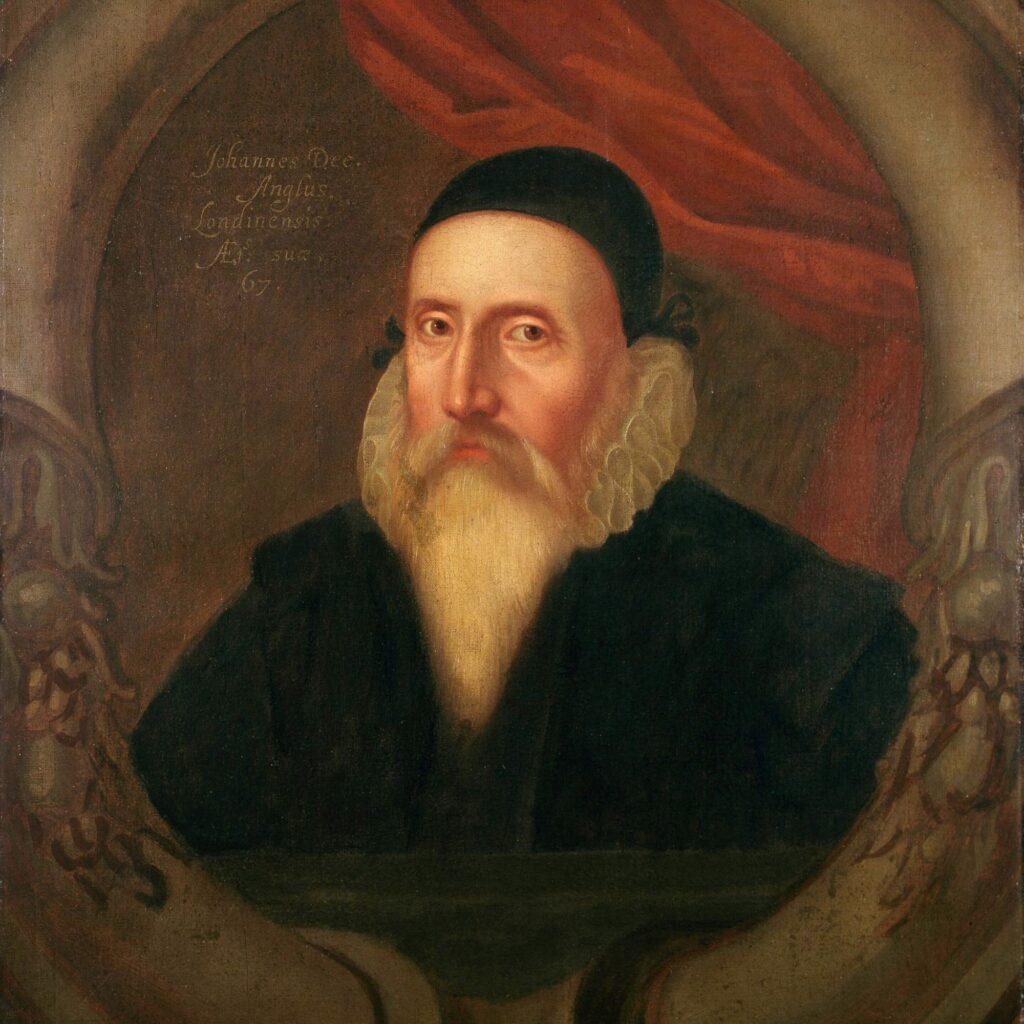
Enochian emerged in late 16th-century England, through the work of Dr. John Dee, a mathematician, astronomer, and advisor to Queen Elizabeth I, and his associate Edward Kelley, a scryer and medium.
Between 1582 and 1589, Dee and Kelley claimed to receive communications from angelic beings during ritual séances. According to their accounts, these beings revealed a sacred language said to be the tongue of angels and the language spoken by the biblical patriarch Enoch, from whom the system takes its name.
Dee meticulously recorded these communications in extensive journals, forming the primary source material for Enochian.
—
The Nature of Enochian
Unlike Esperanto or Interlingua, Enochian was not designed with practical goals in mind. Its purpose was ritualistic, symbolic, and cosmological.
Enochian was presented as:
a divine language predating human speech,
a key to understanding the structure of the universe,
a tool for communicating with spiritual entities.
This claim places Enochian outside traditional linguistics and into the realm of mysticism and esoteric philosophy.
—
Structure and Linguistic Features
From a linguistic perspective, Enochian displays both natural-language-like features and artificial elements.
Vocabulary
Enochian has a limited but distinct lexicon, much of which appears unrelated to known languages. However, some words show phonetic resemblance to English, Latin, or Hebrew, leading scholars to debate its origins.
Grammar
The grammar of Enochian is partially documented but inconsistent. Some sentences show structured syntax, while others appear formulaic or symbolic rather than conversational.
This inconsistency fuels debates over whether Enochian is:
a true language,
a ritual code,
or a symbolic system expressed through linguistic form.
—
The Enochian Alphabet
One of the most visually striking aspects of Enochian is its unique alphabet, often referred to as the Enochian script.
The characters are angular, geometric, and visually ritualistic. They were reportedly dictated by angels letter by letter, with precise instructions on form and order.
The alphabet reinforces the idea that Enochian was meant to be seen as much as spoken.
—
The Enochian Calls (Keys)
Central to Enochian practice are the 19 Enochian Calls, also known as Keys. These are invocations written primarily in Enochian and intended to open metaphysical realms or states of consciousness.
Each Call is associated with:
spiritual hierarchies,
cosmological directions,
elemental forces.
Even today, these Calls are studied and used within ceremonial magic traditions.
—
Debates and Skepticism
Enochian has long been the subject of intense debate.
Skeptical Views
Critics argue that:
Enochian reflects unconscious linguistic invention,
Edward Kelley may have fabricated portions,
the system lacks the complexity of a natural language.
Supportive Views
Supporters counter that:
the internal consistency exceeds chance invention,
Dee’s scholarly rigor argues against deception,
the system’s depth suggests a genuine symbolic framework.
Modern linguistics does not validate Enochian as a natural language, but also does not fully dismiss its complexity.
—
Enochian as a Proto-Conlang
From a modern perspective, Enochian can be viewed as an early proto-conlang — created centuries before the formal study of constructed languages.
It predates:
Esperanto,
Volapük,
philosophical languages of the Enlightenment.
In this sense, Enochian represents one of humanity’s earliest attempts to systematically invent a language, regardless of its claimed origin.
—
Cultural Influence
Enochian has had lasting influence in:
Western occult traditions,
literature and poetry,
music (especially experimental and black metal scenes),
modern fantasy and esoteric art.
It continues to inspire creators seeking languages with mystery, power, and symbolic depth.
—
Why Enochian Still Matters
Enochian matters not because it is spoken, but because it challenges assumptions about language itself.
It raises enduring questions:
Can language be revealed rather than invented?
Is meaning always human-made?
Where does symbolism end and language begin?
Few linguistic systems provoke such questions so directly.
—
Conclusion
Enochian stands at the crossroads of language, mysticism, and human imagination. Whether viewed as divine revelation, elaborate symbolic art, or subconscious linguistic creation, it remains a singular phenomenon.
It is not a language of daily speech, nor one of logic or simplicity. Enochian is a language of mystery, designed to be contemplated rather than mastered.
In that sense, Enochian is less a tool for communication and more a mirror — reflecting humanity’s timeless desire to touch the unknown through words.