
Introduction
Most languages exist to connect people. Some constructed languages aim to unite nations or simplify communication. Ithkuil does neither. Instead, it asks a far more radical question: What if a language were designed not for ease or popularity, but for absolute precision of thought?
Created in the early 21st century, Ithkuil is widely considered the most complex constructed language ever devised. It challenges fundamental assumptions about how language works, how humans think, and whether ambiguity is a flaw—or an essential feature—of communication.
—
The Creation of Ithkuil
Ithkuil was created by John Quijada, an American linguist and conlanger, and officially released in 2004. Quijada’s motivation was deeply philosophical. He observed that natural languages are filled with:
vagueness,
redundancy,
semantic drift,
and cultural bias.
Rather than accepting these limitations, Quijada sought to design a language that could encode cognitive intent directly, minimizing interpretation and misunderstanding.
Ithkuil was never intended to be spoken fluently by communities. It was conceived as a thought experiment — a linguistic extreme meant to explore the boundaries of human expressiveness.
—
The Philosophy Behind Ithkuil
At its core, Ithkuil is driven by one central idea:
> Human language can be made more efficient than human thought allows.
Ithkuil challenges the assumption that natural language reflects cognition perfectly. Instead, it attempts to restructure language so that meaning is expressed before ambiguity arises.
Its philosophical foundations include:
cognitive science,
formal logic,
semiotics,
and systems theory.
Where most languages allow context to clarify meaning, Ithkuil demands that meaning be specified explicitly.
—
A Language Against Ambiguity
Natural languages rely heavily on context, implication, and shared cultural understanding. Ithkuil rejects this approach.
In Ithkuil:
emotional intent,
epistemic certainty,
speaker attitude,
causal relationships,
and contextual assumptions
are often encoded directly into the word itself.
This results in expressions that are incredibly precise—but cognitively demanding.
—
Structural Complexity
Ithkuil’s structure is notoriously intricate.
Morphology Over Syntax
Unlike languages that rely on word order, Ithkuil uses dense morphological structures. A single word can contain information that would require an entire paragraph in English.
Each word may encode:
grammatical role,
aspect,
mood,
intention,
relation to other concepts,
degree of abstraction,
and speaker perspective.
—
Phonology and Script
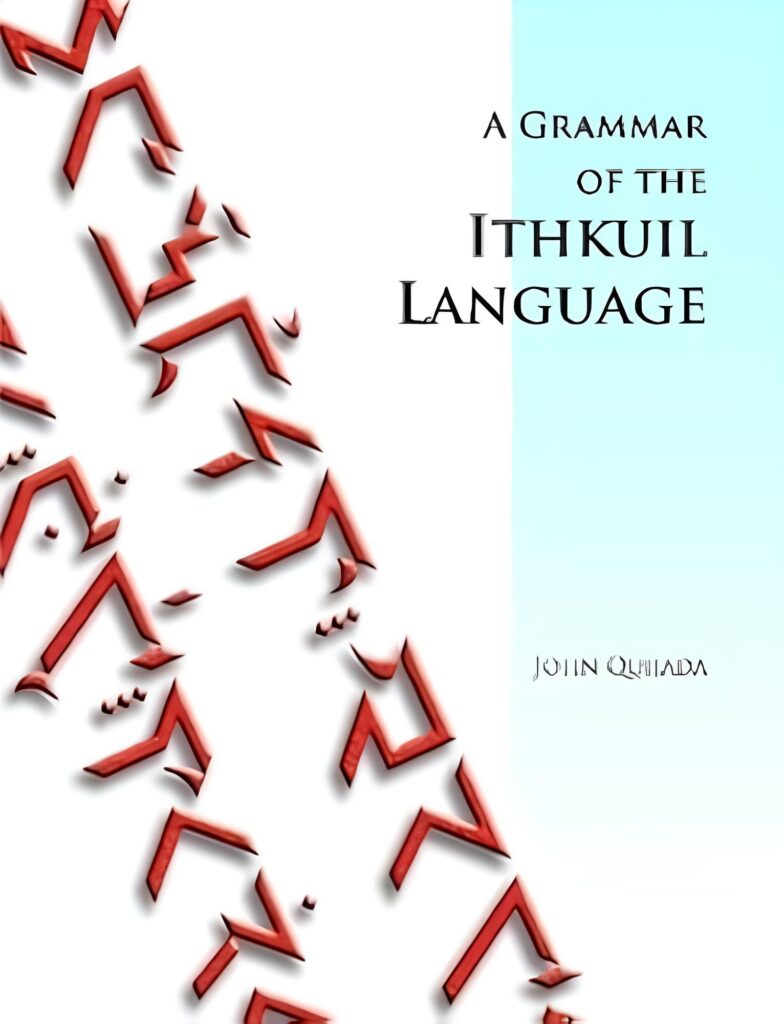
Ithkuil features a highly unusual phonological system and multiple scripts. Its writing system is designed to reflect conceptual relationships, not just sounds.
Later revisions of the language (such as Ilaksh and Ithkuil IV) attempted to make the phonology more pronounceable, but the language remains extremely difficult.

—
Cognitive Cost
The primary criticism of Ithkuil is not its logic, but its cognitive burden.
To speak Ithkuil fluently, a speaker would need to:
consciously analyze their own intent,
select from dozens of grammatical categories,
maintain precise awareness of conceptual relationships.
In practice, this makes spontaneous conversation nearly impossible.
Ironically, a language designed to make thought more efficient may actually slow thinking down.
—
Revisions and Evolution
John Quijada has revised Ithkuil several times, responding to feedback and philosophical reflection. These revisions include:
simplification of phonology,
partial restructuring of grammatical systems,
introduction of alternate scripts.
However, Quijada has consistently maintained Ithkuil’s core mission: precision over usability.
—
Cultural Impact and Popularity
Despite its impracticality, Ithkuil has gained cult status.
It has been featured in:
linguistic documentaries,
academic discussions,
online communities,
and popular media exploring extreme human ideas.
Ithkuil is often cited as:
> “The hardest language ever created.”
This reputation has cemented its place in linguistic history.
—
Why Ithkuil Matters
Ithkuil’s importance does not lie in adoption, but in implication.
1. A Mirror to Natural Language
It exposes how much natural languages rely on ambiguity and assumption.
2. A Challenge to Linguistic Design
It forces linguists to confront trade-offs between precision and usability.
3. A Philosophical Tool
Ithkuil is as much about thinking as it is about speaking.
—
Conclusion
Ithkuil is not a language meant to be learned casually or spoken daily. It is a boundary marker—a linguistic extreme that shows what happens when clarity is pushed beyond human comfort.
In doing so, it asks a profound question:
Is perfect precision in language a goal worth pursuing, or is ambiguity an essential part of being human?
Ithkuil does not answer this question—but it ensures we can never ignore it.